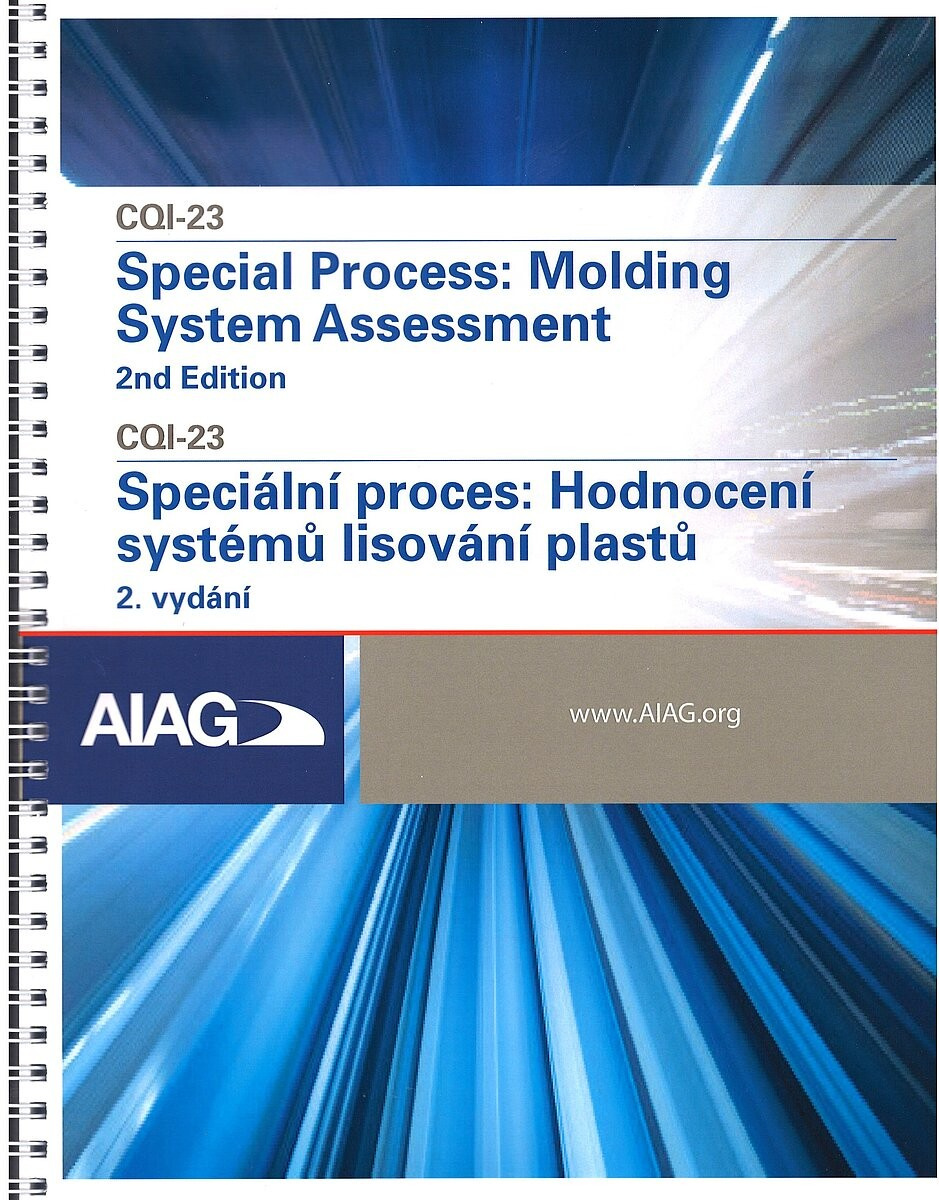
CQI-23-2
Special Process: Molding System Assessment
This 2nd edition has been replaced by the new: CQI 23-3:2026 Special Process: Molding System Assessment
| Standard number: | CQI-23-2 |
| Version: | Hardcopy with downloadable Assessment |
| Released: | February 2023 |
CQI-23-2 Special Process: Molding System Assessment
with Downloadable Assessment
AIAG's Molding System Assessment is a common process approach to control molding processes and a methodology to evaluate and amend, as needed, current processes. The assessment provides best practices for continual improvement, emphasizing defect prevention and the reduction of variation and waste in the supply chain. The CQI-23 includes the assessment as a downloadable Excel file.
Excel file CQI 23 content these tables:
Cover sheet
Section 1 - Management Responsibility & Quality Planning
Section 2 - Floor and Material Handling Responsibility
Section 3 - Job Audit - Finished Product Review
PROCESS TABLE A - Injection Molding
PROCESS TABLE B - Blow Molding
PROCESS TABLE C - Vacuum Forming
PROCESS TABLE D - Compression Molding (SMC)
PROCESS TABLE E - Resin Transfer Molding (RTM)
PROCESS TABLE F - Extrusion
PROCESS TABLE G - Equipment
PROCESS TABLE H - Part Inspection and Testing
✅ What CQI-23-2 Is
CQI-23-2 is a process assessment used to evaluate the capability and robustness of plastic molding operations within the automotive supply chain. It helps organizations ensure consistent quality, reduce variation, and meet OEM requirements.
It complements—but does not replace—systems like IATF 16949, focusing specifically on plastic molding processes such as:
-
Injection molding
-
Blow molding
-
Compression molding
-
Transfer molding
✅ Purpose of CQI-23-2
The standard is designed to:
-
Assess the maturity and control of molding processes
-
Identify risks and prevent defects
-
Ensure stable and repeatable molding production
-
Promote continual improvement
-
Support supplier–customer quality expectations
✅ Key Elements of the Assessment
1. Management & Planning
-
Roles and responsibilities
-
Training and competence
-
Control plans and PFMEAs
-
Process documentation
2. Process Control & Monitoring
-
Machine setup and verification
-
Material handling and identification
-
Mold maintenance and condition monitoring
-
Process parameter control and recording
3. Equipment & Tooling
-
Molding machines
-
Auxiliary equipment (dryers, chillers, etc.)
-
Mold preventive maintenance schedules
-
Calibration of sensors and measurement devices
4. Product Quality Assurance
-
First-piece approvals
-
In-process inspections
-
Dimensional and visual verification
-
Traceability and change management
5. Layered Process Audits / Self-Assessments
The assessment includes:
-
Annual self-assessment requirement
-
Scoring to determine compliance level
-
Action plans for any gaps or “not satisfied” items
✅ What’s New in the 2nd Edition (CQI-23-2)
At a high overview level, the second edition typically includes:
-
Updated process questions and criteria
-
Improved alignment with IATF 16949 requirements
-
More emphasis on maintenance strategies
-
More robust documentation expectations
-
Clarified assessment scoring and guidance