BS EN 18216 - BS EN 18223
Digital Product Passport Standards
Saving is 100 € compared to buying individual titles!
| Released: | 2026/05 |
| Standard number: | BS EN 18216 - BS EN 18223 |
| Pages: | 200 |
DPPS
Digital Product Passport Standards
Commission Implementing Decision (EU) 2026/1736 of 14 July 2026 on harmonized standards for digital product passports drafted in support of Regulation (EU) 2024/1781 of the European Parliament and of the Council
This set contains these main standards:
-
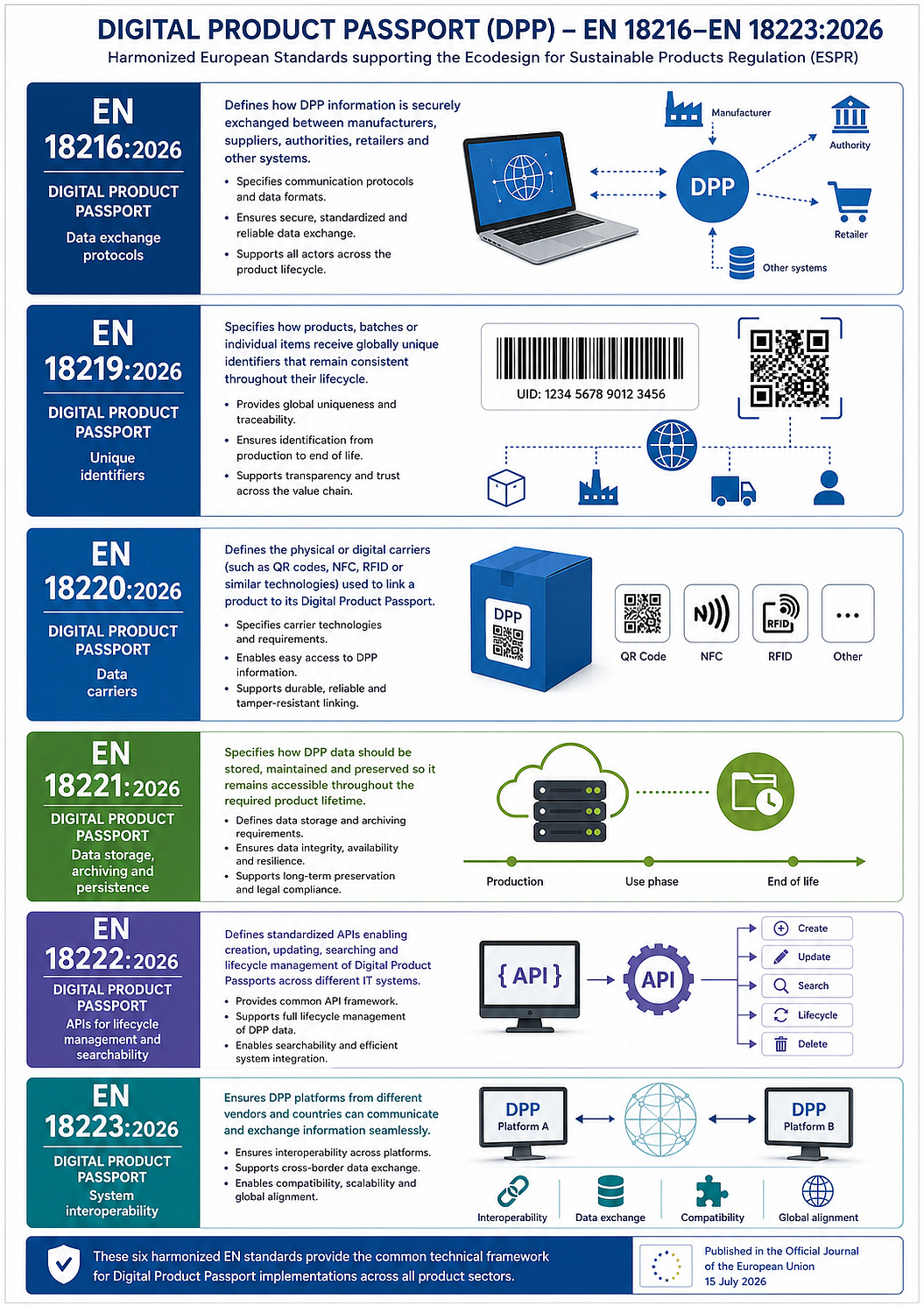
BS EN 18216:2026 Digital product passport. Data exchange protocols
This document defines a standard for secure and efficient data exchange protocols and data formats to be used for the digital product passport. Data exchange protocols establish the rules and procedures that systems follow when communicating and exchanging information. Data formats define the structure and presentation of that information so it can be understood and processed correctly by the involved systems. Together, protocols and formats ensure that data can be exchanged in a manner that is secure, interoperable, reliable, and compatible across various platforms and sectors.
This will guarantee that data are human and machine-readable, structured, searchable, and transferable through an open, interoperable network without vendor lock-in.
Secure communication:
This document defines protocols that ensure secure and authenticated data exchange between systems, ensuring that data are protected against unauthorized access and, when necessary, only authorized entities can access the information.
Interoperability for data exchange:
The protocols and data formats defined in this document support easy integration with existing data exchange systems, ensure compatibility of protocols and formats across various sectors and supporting a wide range of applications and use cases.
Ease of use and integration:
Ensure that the identified protocols and formats can be implemented easily, especially for mobile devices, and are user-friendly in order to facilitate widespread adoption.
Data integrity:
The protocols and data formats defined in this document ensure the integrity of information linked to physical objects and electronic data throughout the entire value chain, extending to the product's or asset's end-of-life.
Documentation and discoverability:
The protocols and formats are available to individuals without specialized knowledge, enabling broader adoption across sectors.
In order to promote interoperability, reduce costs for businesses, and align with existing European regulations and initiatives, this document considers the data exchange protocols and data formats already in use in other legislations. Relevant existing standards are integrated into the development process to ensure consistency and coherence with industry practices and regulatory frameworks.
-
BS EN 18219:2026 Digital product passport. Unique identifiers
This document defines the principles and specifies the requirements and guidelines for unique product identifiers, unique economic operator identifiers, and unique facility identifiers used in digital product passports. It covers the following areas:
global uniqueness;
persistence;
syntax;
granularity;
interoperability;
openness.
This document accommodates unique product identifiers at three granularity levels of specificity: model, batch, or individual item, to support various operational needs.
This document describes identification (ID) schemes that use issuing agencies, self-issuing systems, or a combination of both.
-
BS EN 18220:2026 Digital product passport. Data carriers
This document specifies requirements for data carriers used in a digital product passport system. This covers: symbology characteristics, format, error correction codes, encoding methods, printing and production quality, and durability.
This document also specifies requirements on graphical or other indicators for easy recognition of DPP data carriers and the indication on the data carrier placement, machine readability, quality checking, links between physical product and digital representation.
The following aspects are out of scope: architecture and use cases, secure elements and any other cryptographic security features.
-
BS EN 18221:2026 Digital product passport. Data storage, archiving, and data persistence
This document specifies requirements for data storage, archiving, and data persistence of digital product passports, all based on a decentralized approach. The archiving functionality securely stores historical passport data, preserving a comprehensive record of past information. Persistence ensures that data included in the digital product passport remains available even when the economic operator creating the digital product passport is no longer active.
This document also specifies requirements for the replication between economic operators and back-up operators as well as rules for data lifetime definition.
-
BS EN 18222:2026 Digital Product Passport. Application Programming Interfaces (APIs) for the product passport lifecycle management and searchability
This document aims to standardize the specifications for the API of the digital product passport (DPP) as mandated by the ESPR of the European Commission. The purpose of this API is to facilitate the
searchability of DPPs, as well as to provide the necessary means for interactions throughout the lifecycle of a product's DPP.
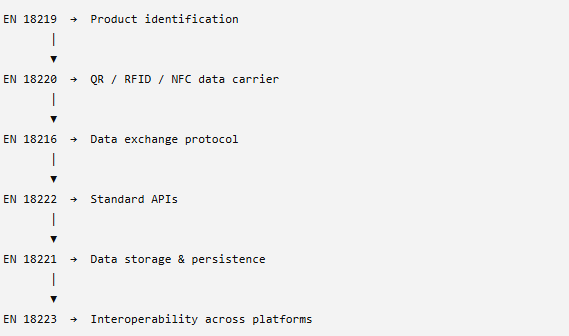
Relationship between the standards
Why are these standards matter
These six standards form the horizontal technical framework for Digital Product Passports. They do not specify what information must be stored for batteries, textiles, electronics or other product groups. Instead, they define the common infrastructure used by all sectors:
- product identification
- machine-readable data
- communication between systems
- APIs
- long-term data storage
- interoperability
Sector-specific delegated acts under the ESPR will define exactly which product data must be included for each product category.
Who should use them?
These standards are particularly relevant for:
- Manufacturers placing products on the EU market
- ERP, PLM and MES software providers
- Digital Product Passport platform developers
- Supply chain software providers
- Market surveillance authorities
- Importers and distributors
- Sustainability and compliance consultants
Legal significance
Because these standards have now been cited in the Official Journal:
- they are harmonized EN standards;
- applying them provides a presumption of conformity with the relevant DPP requirements of the ESPR;
- they are expected to become the technical foundation for Digital Product Passport implementations across Europe.