IPC-J-STD-012 - Standard Only
Implementation of Flip Chip & Chip Scale Technology
| Standard Number: | IPC-J-STD-012 - Standard Only |
| DOD Adopted: | No |
| ANSI Approved: | No |
| Released: | 01.01.1996 |
| Pages (English): | 120 |
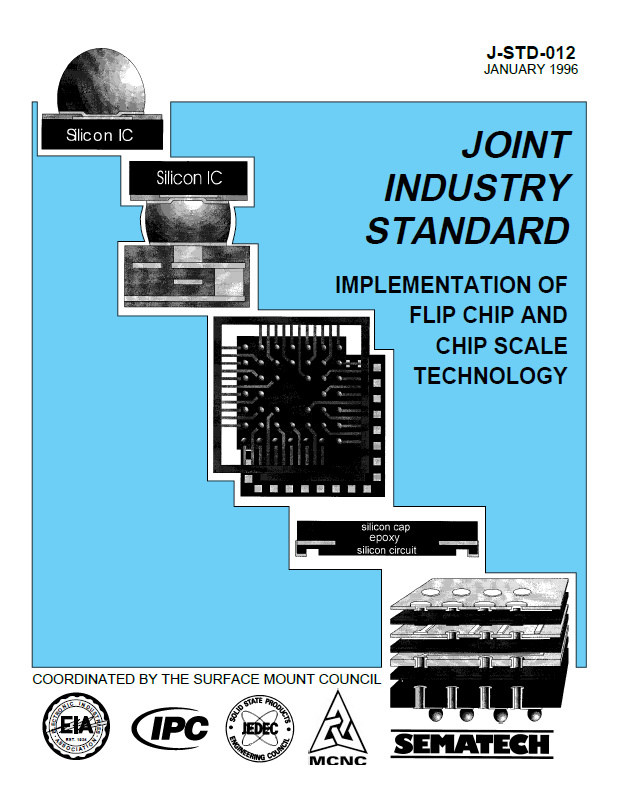
This informative document describes the implementation of flip chip and related chip scale semiconductor packaging technologies. The areas discussed include design considerations, assembly processes, technology choices, application and reliability data. Chip packaging variations include flip chip, HDI, micro BGA, micro SMT and SLICC. Also provides general information on implementing flip chip and chip scale technologies for creating multichip modules, I/C cards, memory cards and very dense surface mount assemblies. Developed by IPC, EIA, MCNC and Sematech. 113 Pages. Released January 1996.
Equivalent to IEC Publicly Available Standard (PAS) 6208
IPC-J-STD-012 - Standard Only
The IPC-J-STD-012 is a pivotal standard in the realm of electronics manufacturing, specifically focusing on the Implementation of Flip Chip & Chip Scale Technology. Released on January 1, 1996, this standard has been a cornerstone for professionals seeking to enhance their understanding and application of advanced chip technologies.
Overview of IPC-J-STD-012
As the electronics industry continues to evolve, the demand for more compact, efficient, and reliable components has never been higher. The IPC-J-STD-012 standard addresses these needs by providing comprehensive guidelines for the implementation of flip chip and chip scale technologies. These technologies are crucial for the development of smaller, faster, and more efficient electronic devices.
Key Features and Benefits
- Comprehensive Guidelines: The standard offers detailed instructions and best practices for implementing flip chip and chip scale technologies, ensuring that manufacturers can achieve optimal performance and reliability.
- Industry Relevance: Although released in 1996, the principles and practices outlined in this standard remain highly relevant, providing a solid foundation for modern electronics manufacturing.
- Enhanced Performance: By following the guidelines of IPC-J-STD-012, manufacturers can produce devices that are not only smaller and lighter but also more powerful and efficient.
- Cost Efficiency: Implementing these technologies can lead to significant cost savings in production, as they allow for more efficient use of materials and resources.
Technical Specifications
The IPC-J-STD-012 standard is identified by the standard number IPC-J-STD-012 - Standard Only. It is important to note that this standard has not been adopted by the Department of Defense (DOD) nor approved by the American National Standards Institute (ANSI). Despite this, it remains a valuable resource for those in the electronics manufacturing industry.
Why Choose IPC-J-STD-012?
Choosing the IPC-J-STD-012 standard means opting for a tried-and-tested framework that has stood the test of time. Its focus on flip chip and chip scale technologies makes it an essential tool for manufacturers looking to stay ahead in a competitive market. By adhering to this standard, companies can ensure that their products meet high-quality benchmarks, leading to increased customer satisfaction and market success.
Applications of Flip Chip & Chip Scale Technology
Flip chip and chip scale technologies are integral to a wide range of applications, including:
- Consumer Electronics: From smartphones to tablets, these technologies enable the production of sleek, high-performance devices that consumers demand.
- Automotive Industry: As vehicles become more technologically advanced, the need for compact and efficient electronic components grows, making these technologies indispensable.
- Medical Devices: In the medical field, where precision and reliability are paramount, flip chip and chip scale technologies provide the necessary performance enhancements.
- Telecommunications: The rapid advancement of telecommunications infrastructure relies heavily on the capabilities provided by these technologies.
Conclusion
In conclusion, the IPC-J-STD-012 - Standard Only is an invaluable resource for any professional involved in electronics manufacturing. Its focus on the implementation of flip chip and chip scale technologies ensures that manufacturers can produce cutting-edge products that meet the demands of today's market. By integrating the guidelines of this standard into your manufacturing processes, you can achieve superior product quality, efficiency, and performance.
Embrace the future of electronics manufacturing with the IPC-J-STD-012 standard and ensure your products are at the forefront of technological innovation.